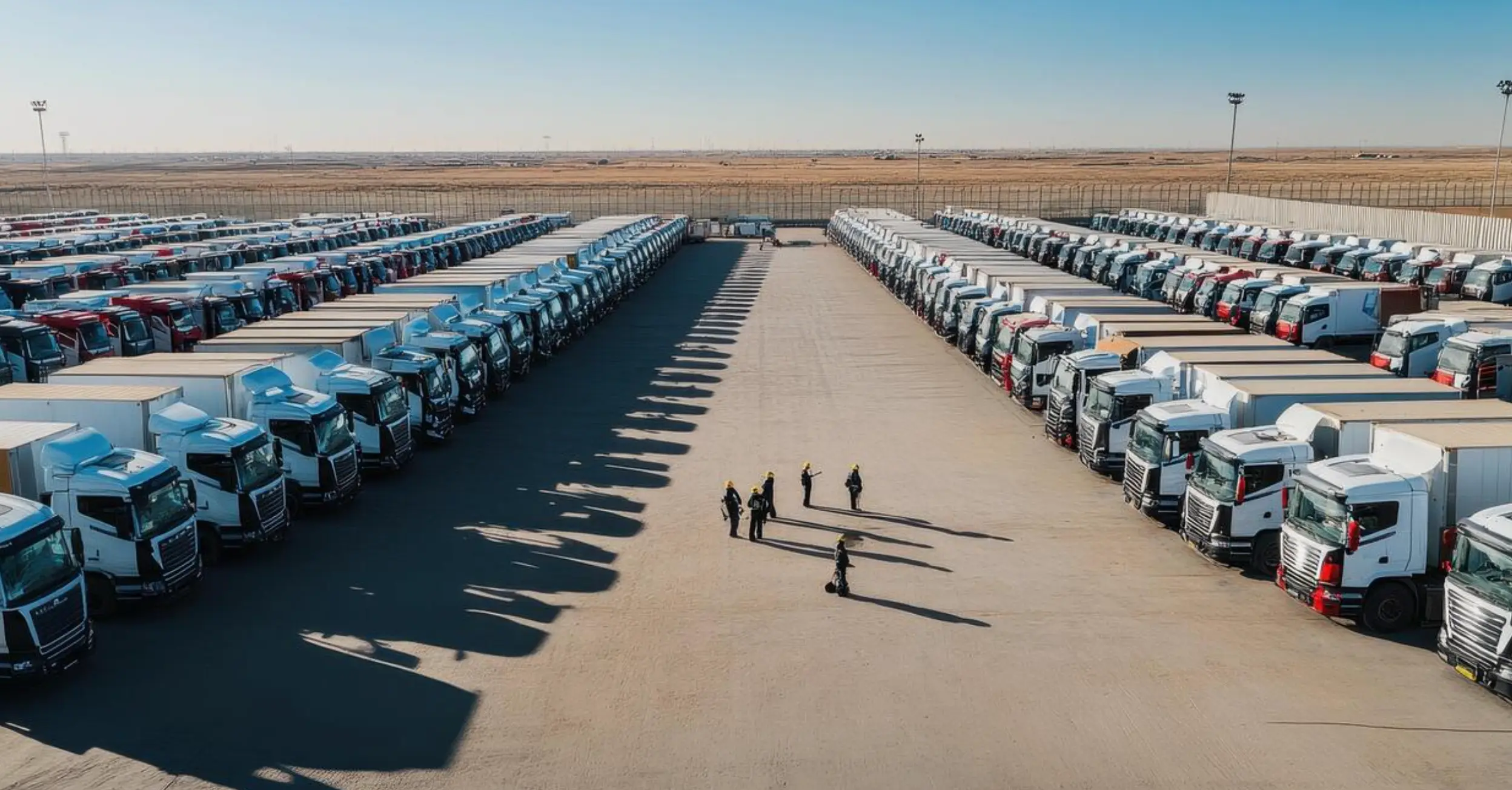

Automated dispatch software has already transformed long-haul transportation and in-warehouse execution. But there is still a stubborn operational gap where freight loses time, visibility, and accountability: the yard.
That gap matters more than most teams want to admit. More than $50B worth of goods move every day through 50,000+ warehouses and factories in North America, and logistics operators are being pushed to do more with less. Facility footprints keep expanding, e-commerce expectations keep rising, and the working-age labor pool is not growing at the same pace. In practice, that combination forces a shift from “managing by radio” to managing by systems.
Automated dispatch software is one of the most leverageable steps. When it is done right, it does not just assign moves. It orchestrates arrivals, gate transactions, yard locationing, dock scheduling (for which best dock scheduling software can be utilized), and spotter tasks as one continuous execution layer.
This article breaks down what “automated dispatch” should mean in a modern yard, what capabilities actually drive throughput and cost reduction, what to look for in an RFP, and how an AI-native Yard Operating System (which can transform efficiency and visibility) can close the loop from gate to dock.
Why “dispatch” keeps failing in the yard
In transportation, dispatch software is usually a scheduling and optimization problem: assign loads to drivers, pick routes, track milestones, and manage exceptions.
In the yard, dispatch is a real-time execution and constraint management problem:
Assets arrive early, late, or not at all.
Trailer and container locations are frequently wrong or stale.
Moves are interdependent (you cannot stage a live load if the door is blocked, the paperwork is missing, or the reefers are in the wrong zone).
High-frequency exceptions happen continuously: rejected loads, missed appointments, damaged equipment, wrong seal, missing placards, no-shows, high-value verification, temperature excursions.
This is why the yard is often described internally as a black hole. Many operations have a strong WMS and a functioning TMS (which could benefit from cloud-based vs on-premise yard management software solutions), yet still rely on phone calls, whiteboards, guard shacks, and tribal knowledge to keep the yard moving. The software gap is not just inconvenient; it is expensive.
A few industry-standard cost buckets make this clear:
Driver detention: Detention is commonly charged when turn times exceed contract thresholds (often after 1–2 hours, depending on shipper and lane). Even where detention is contested, poor turn time damages carrier relationships and tightens capacity.
Demurrage and per diem: Containerized and intermodal flows are subject to daily charges when boxes sit too long. These are policy-driven, not negotiable, and the only real defense is clean execution and audit-ready timestamps.
Labor inefficiency: Yard jockeys, gate guards, and supervisors burn time searching for equipment, coordinating moves (which could be streamlined with digital dock scheduling software)
The yard digitization gap: WMS and TMS are not enough
Warehouse Management Systems (WMS) excel at inventory, tasking, and labor within four walls. Transportation Management Systems (TMS) excel at tendering, routing, and linehaul visibility. However, the yard sits between them.
That middle layer needs its own execution system because it has unique objects and workflows:
Objects: trailers, containers, chassis, tractors, demountables, power-only moves, reefers, sealed assets, empty returns.
Locations: parking stalls, reefer rows, high-value zones, inspection lanes, drop lots, inbound staging, outbound staging, door positions, live load slots, quarantine.
Events: gate in/out, seal verification, damage capture, yard moves, dwell, door assignment, rejection and rework loops.
Without a dedicated yard execution system like yard management software, WMS and TMS signals degrade at the boundary. A WMS can “wave” work to ship but if the trailer is not actually staged at the correct door that wave becomes noise. A TMS can schedule an appointment but if the yard cannot process arrivals and assign parking intelligently the appointment system becomes a queue generator.
This is where automated dispatch software purpose-built for yards earns its keep.
What automated dispatch software should do in a modern yard
Most products claim “automation,” but in yard operations the word should map to specific capabilities with measurable outcomes.
1) Convert appointment intent into executable yard plans (pre-arrival planning)
Pre-arrival planning is where dispatch performance is won. It should include:
Appointment ingestion from TMS, WMS, dock scheduler and EDI/API feeds.
Asset attribute capture: carrier, trailer type, reefer status, commodity, hazard class high-value flags temperature setpoints seal requirements.
Rules-based staging intent: where an asset should park on arrival where it should stage prior to door and what verification steps it requires.
In a strong system planning is not a static schedule. It is a constraint-aware continuously updated plan that can absorb late trucks early arrivals and sudden dock changes without breaking.
In addition to this automation aspect of yard operations can be further enhanced by integrating advanced freight rate management software which allows for better cost optimization. Moreover utilizing yard management software can significantly improve dock scheduling and asset utilization. Furthermore implementing supply chain execution software can help optimize WMS TMS OMS interactions while avoiding the hidden costs of outdated yard management software which can severely impact overall operational efficiency.
2) Automate check-in and check-out as data events, not paperwork
Gate processes are often treated as security theater and admin work. In reality, gate timestamps are the legal and financial backbone for detention disputes, demurrage auditing, chain of custody, and incident investigations.
Modern automated dispatch software should support:
Guarded, remote-assisted, and fully automated gate modes.
Configurable workflows for high-risk loads: additional identity checks, seal verification, blacklist screening, and exception routing.
Automatic creation of yard inventory records at check-in, including asset identifiers and key attributes needed downstream.
To be clear, this is not about “going unmanned” for the sake of it. It is about turning the gate into a reliable digital event stream that dispatch logic can trust.
3) Maintain real-time yard inventory with high data integrity
Dispatching spotters is only as good as your location data. If the system thinks the trailer is in Row D Stall 12 but it is actually in Row F, you will generate false tasks and waste moves.
This is why the yard is a natural fit for computer vision and sensor-driven verification. When location truth is captured continuously, automated dispatch becomes far more aggressive and effective.
Key requirements for yard inventory integrity include:
High-confidence asset identification.
Continuous reconciliation between planned vs observed locations.
Exception handling when assets appear where they should not be, or disappear from expected zones.
Incorporating logistics optimization software can significantly enhance supply chain efficiency by automating these processes.
4) Orchestrate spotter moves as a queue with priorities, constraints, and feedback
“Dispatch” is often implemented as manual assignment: a supervisor tells a jockey what to do next. Automated dispatch should act like an air traffic control system for yard moves.
The system should:
Generate move tasks automatically from dock demand, outbound cutoffs, inbound availability, and yard rules.
Prioritize tasks based on service risk and operational impact (door starvation, carrier dwell, outbound departure windows).
Avoid thrash, meaning it should not constantly reshuffle tasks unless a material constraint changes.
Close the loop with confirmations: when a move is completed, the yard inventory updates immediately and downstream tasks can trigger.
Done well, this creates stable execution rhythms across two or three shifts instead of the common pattern of “quiet mornings and chaotic afternoons.”
5) Provide exception intelligence, not just alerts
Yards do not fail because people lack alerts. They fail because alerts are noisy and do not encode what to do next.
High-performing automated dispatch software should support:
Root-cause categorization: why dwell is increasing (appointment mismatch, door constraint, paperwork, missing pickup number, equipment damage, security hold).
Prescriptive next steps: where to route an exception, who to notify, what verification step is required.
Audit trails with timestamps and evidence, which is critical for claims, detention disputes, and compliance.
The KPI layer: what you should measure (and what leadership actually cares about)
For operational and digital transformation leaders, automated dispatch software should improve KPIs that are both measurable and financially meaningful:
Gate turn time (arrival to check-in completion, check-in to yard placement, check-out duration)
Trailer dwell time (by status: empty, loaded inbound, loaded outbound, rejected, hold)
Door utilization (door idle time, live load cycle time, door blocking frequency)
Move productivity (moves per hour per spotter, empty miles, rehandles)
Asset search time (how long it takes to locate a specific trailer or container)
Detention and accessorial exposure (cost and volume, by site and carrier)
Throughput (loads shipped/received per day, peak hour performance)
When these KPIs improve, the results usually show up in three places executives track tightly: cost-to-serve, service performance, and resilience.
What to look for in an RFP for automated dispatch software
Most RFPs get stuck on feature checklists and UI preferences. For yards, you want to bias toward execution integrity, scalability, and time-to-value.
Here are the areas that deserve real scrutiny.
Data capture and accuracy
How does the system identify and verify assets at the gate and in the yard?
What accuracy does it achieve in real conditions (night lighting, weather, dirty equipment, mixed trailer types)?
How does it reconcile conflicts between user-entered data and observed data?
Workflow configurability
Can you configure verification steps for high-value or high-risk loads?
Can asset or load attributes trigger different check-out or staging workflows?
Can you model different traffic patterns (bi-directional gates, separate inbound/outbound lanes, peak surges)?
Rules engine and location logic
Can the platform enforce parking preferences based on asset attributes?
Can it optimize staging based on dock demand and yard congestion?
Can it prevent misparking and create “smart zones” for reefers, hazmat, quarantine, and prioritized outbound?
Integration depth
Can it integrate cleanly with existing WMS, TMS, access control, gate arms, kiosks, and appointment systems?
Does it support real-time events via APIs or webhooks?
Can it serve as the “system of record” for yard execution while still feeding upstream systems?
Deployment speed and IT lift
Can you deploy without trenching or major infrastructure projects?
How quickly can you go live at one site, and then replicate across a network?
What does ongoing support look like for rule changes, workflow tuning, and scaling?
Network-level visibility
If you operate five or more sites, the platform should not be a collection of disconnected instances. You want a single operational language across yards, with a consistent KPI layer and shared governance.
Why AI-native yard execution changes the dispatch equation
Classic dispatch tools assume humans will provide the truth: where assets are, what they contain, what their status is. In the yard, that assumption breaks quickly.
AI-native yard execution flips the model:
Computer vision captures asset identity and movement.
A real-time data layer creates a trustworthy yard inventory.
Automation logic dispatches tasks based on what is actually happening, not what someone last typed into a spreadsheet.
Exceptions become structured workflows with evidence attached.
This is also where decision intelligence becomes practical. Once you have consistent event streams, you can start predicting congestion, spotting dwell risks earlier, and proactively staging outbound capacity before bottlenecks form.
Where Terminal fits: automated dispatch as part of a full Yard Operating System
Terminal Industries focuses specifically on yard operations and the operational bridge from gate to dock. The Terminal Yard Operating System™ (YOS) is designed as an end-to-end yard execution platform that combines:
AI-powered computer vision and a modern data infrastructure (built to deliver high data accuracy in real yard conditions)
SmartYard™ YMS workflows that support automation at the gate and orchestration across yard activities
Advanced Yard capabilities for security, compliance, and operational control
Yard Networks for single-pane-of-glass visibility and repeatable rollout across multi-site operators
In practical terms, Terminal’s approach to automated dispatch is not “just task assignment.” It is about building a reliable execution layer that unlocks the value of your WMS and TMS by removing the yard blind spot.
A few examples of where that shows up:
Automated gate workflows that capture check-in/check-out events cleanly and consistently, with configurable steps for high-value or high-risk loads.
Asset movement orchestration that assigns and sequences yard move tasks based on real-time yard state, load attributes, and dock needs.
Security workflows like blacklist-driven detection for unauthorized equipment, and enhanced verification rules that can trigger at check-out.
Search-time reduction by maintaining accurate, continuously reconciled yard inventory, which directly improves move efficiency and reduces detention exposure.
Terminal is built for mid-market and enterprise operators with complex yard networks, especially those running multiple shifts, high dock counts, and meaningful yard density where “radio dispatch” becomes a limiting factor.
The integration of dock scheduling software into our YOS further enhances loading dock operations. Coupled with our yard management software, we are able to elevate logistics efficiency significantly.
A realistic path to adoption (without boiling the ocean)
Automated dispatch software succeeds when it is introduced as a controlled execution upgrade, not as a massive “transformation project.”
A practical rollout sequence often looks like:
Digitize gate transactions and standardize event capture (arrivals, departures, asset identity, audit timestamps).
Establish real-time yard inventory with strong reconciliation, so you have location truth.
Automate move task generation for the highest-frequency workflows (door pulls, outbound staging, inbound drops).
Layer in advanced rules for security, compliance, and high-value verification.
Scale across the yard network with shared templates, KPI governance, and continuous tuning.
Terminal’s platform is designed for rapid deployment and repeatable ROI, with many operators targeting payback in months rather than years. The operational win is not abstract. It is fewer wasted moves, faster turn times, less detention exposure, more consistent throughput, and better resilience during peak volatility.
Closing perspective: dispatch is not a feature, it is a system behavior
If you are evaluating automated dispatch software, the most important question is not “Does it have dispatch screens?”
It is this: Does the platform create a reliable, real-time operational truth in the yard, and can it turn that truth into automated execution at scale?
When the yard stops being a data black hole, the rest of your stack finally behaves the way it was promised. WMS waves become executable. TMS appointments become predictable. Supervisors manage exceptions instead of chasing trailers. And leadership gets a yard network that runs with the same discipline as the warehouse and the highway.
That is the bar modern automated dispatch should meet, and it is the standard Terminal is building toward with Terminal Yard Operating System™.
FAQs (Frequently Asked Questions)
What operational challenges does automated dispatch software address in the yard?
Automated dispatch software addresses critical operational gaps in the yard where freight loses time, visibility, and accountability. It manages real-time execution and constraints such as early or late asset arrivals, incorrect trailer locations, interdependent moves, and continuous exceptions like rejected loads or damaged equipment. This helps reduce costly issues like driver detention, demurrage, per diem charges, and labor inefficiencies.
Why are Warehouse Management Systems (WMS) and Transportation Management Systems (TMS) insufficient for yard operations?
While WMS excel at managing inventory and labor within warehouses and TMS handle tendering and routing in transportation, neither fully manage the unique objects, locations, and events of the yard. The yard requires a dedicated execution system to handle trailers, containers, parking stalls, gate transactions, door assignments, and other specialized workflows to prevent signal degradation between WMS and TMS.
How does automated dispatch software improve throughput and cost reduction in modern yards?
Automated dispatch software orchestrates arrivals, gate transactions, yard locationing, dock scheduling, and spotter tasks as one continuous execution layer. By converting appointment intent into executable yard plans with constraint-aware updates that absorb early or late arrivals and other disruptions, it optimizes asset staging and door assignments to enhance throughput while reducing costs related to detention fees, demurrage charges, and labor inefficiency.
What capabilities should I look for in an automated dispatch system for yard management?
Look for a system that integrates appointment ingestion from TMS/WMS/EDI feeds; captures asset attributes like carrier info, reefer status, hazard classes; applies rules-based staging intent; continuously updates plans based on real-time constraints; manages gate transactions; schedules docks efficiently; tracks spotter tasks; and provides audit-ready timestamps to improve visibility and accountability throughout the yard operations.
How does managing by systems differ from traditional 'managing by radio' in yard operations?
Managing by systems replaces manual coordination methods such as phone calls, whiteboards, guard shacks, and tribal knowledge with digital platforms that provide real-time visibility and control. This shift is necessary due to expanding facility footprints, rising e-commerce expectations, and labor shortages. Automated dispatch software enables this transition by orchestrating all yard activities systematically rather than relying on fragmented communication.
What are the financial impacts of not using automated dispatch software in yards?
Without automated dispatch software, yards face increased driver detention costs due to prolonged turn times; demurrage and per diem fees from container dwell times; labor inefficiencies as staff spend excessive time locating equipment or coordinating moves manually; strained carrier relationships; reduced capacity utilization; and overall higher operational expenses caused by lack of visibility and poor execution.


