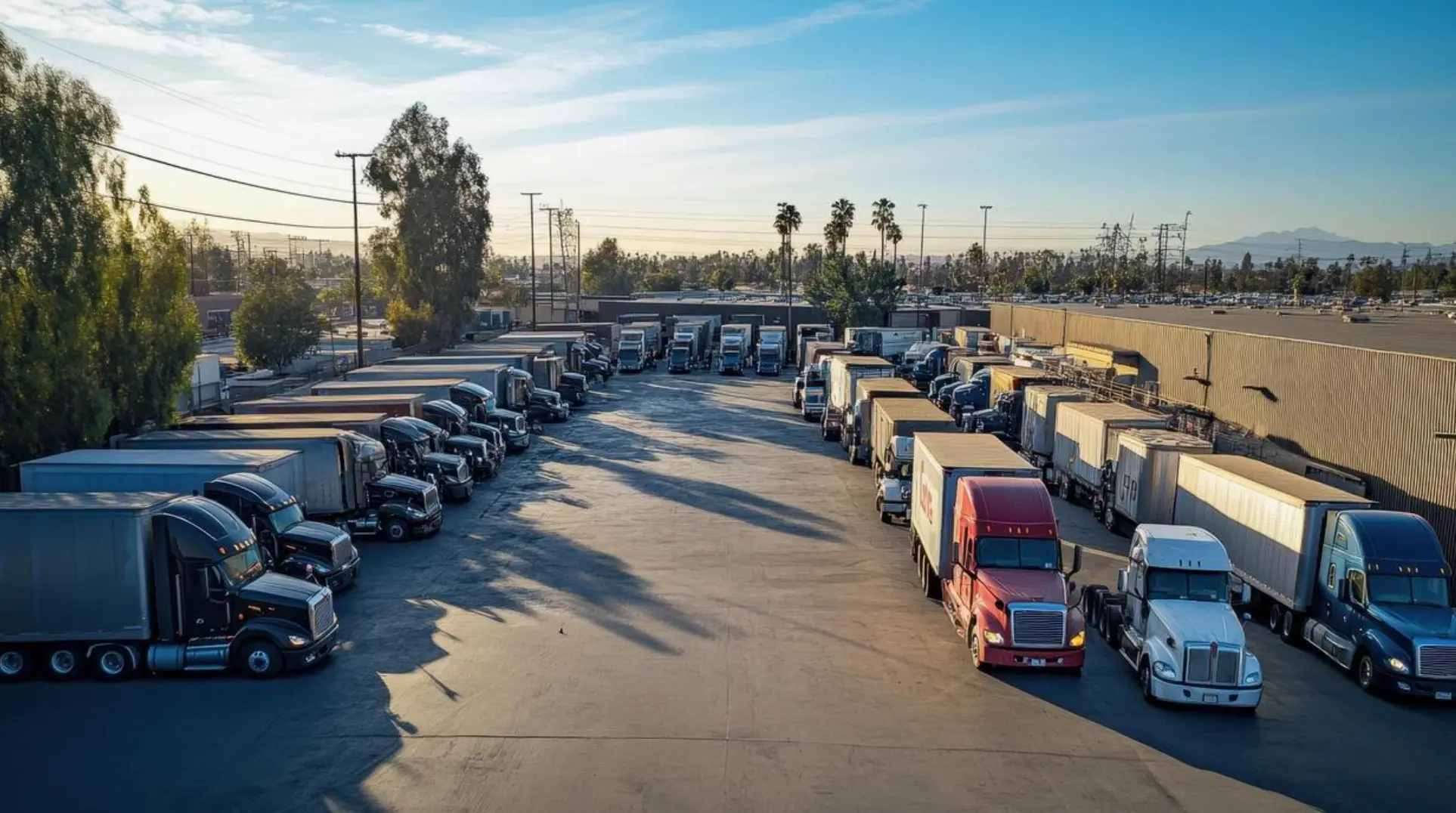

If you run more than one busy yard, you already know the uncomfortable truth: your WMS and TMS can be world-class, and you can still lose hours (and margin) every day between the gate and the dock.
That gap is exactly why yard management companies exist. They bring structure, visibility, and control to the yard, which is still one of the least digitized links in North American supply chains. Industry data points underline the stakes: more than 50K warehouses and factories move $50B+ worth of goods daily across North America, yet the yard often operates with fragmented processes, radio calls, spreadsheets, and tribal knowledge. At the same time, logistics demand is rising, warehouse square footage continues to expand at roughly 10% annually, and labor availability is not keeping pace. Leaders are being pushed to increase throughput with the people and footprint they already have.
This guide breaks down what “yard management companies” typically provide, how to evaluate solutions at an expert level, and how modern approaches like Terminal Industries’ Yard Operating System™ (YOS) are reframing the category from “yard management” to yard execution.
What yard management companies typically provide
Most yard management companies focus on some combination of software, operational consulting, and hardware enablement to improve flow and reduce yard chaos. In practice, their offerings cluster into six core functions.
1) Yard visibility and inventory control
At minimum, you need a reliable answer to: What assets are on property, where are they, and what is their status? That includes:
Trailer/container inventory, dwell time, and status (loaded, empty, quarantined, awaiting inspection)
Door assignments and near-dock staging positions
Yard map and location model (rows, spots, zones, overflow)
Exception handling for unknown assets and mismatched IDs
This is the foundation of a successful yard management system, but it is also where many systems struggle. Visibility is only as good as the data capture method used. Manual scans, driver checklists, and radio updates often degrade quickly during peak volume.
To combat these issues, many companies are turning towards dynamic yard management systems that offer real-time insights into yard operations. These systems not only enhance visibility but also streamline workflows significantly.
In fact, when comparing a traditional check-in process with a modern yard management system, the latter has been proven to save substantial amounts of time while improving efficiency.
Furthermore, with the rise of technology in logistics, businesses now have the option to choose between cloud-based or on-premise yard management software solutions. Each option comes with its own set of advantages that can be tailored to fit specific business needs.
2) Gate and appointment workflows (pre-arrival to check-out)
The gate is where yards win or lose control. Many yard management programs include:
Pre-arrival planning and appointment alignment (with TMS/WMS)
Digital gate check-in and check-out workflows, including load verification
Support for bi-directional traffic flows, carrier rules, and access control integrations
Security protocols for high-value or high-risk loads
In higher-maturity operations, the gate becomes an orchestration point, not just a “pass/fail” checkpoint.
3) Move orchestration (yard jockey/spotter tasking)
When yards get busy, the constraint is rarely “we don’t know what to do.” It’s “we can’t coordinate moves fast enough, and we don’t trust the information.”
A competent yard solution should support:
Task queuing and prioritization (door pull, live load, staging, drop lot)
Location assignment logic and rules-based parking preferences
Status communication to spotters, gate, shipping/receiving, and control towers
KPI instrumentation (moves per hour, idle time, rehandles, exceptions)
Implementing a robust yard management software can greatly enhance coordination during these busy periods.
4) Dock-to-yard synchronization
This is the bridge most operations never fully build. Even strong WMS deployments can get throttled by yard friction:
Doors go idle because assets aren’t staged correctly
Outbound loads miss cutoffs due to search and rehandle delays
Inbound dwell increases because receiving cannot see what is arriving, where it is parked, and what is ready
This is why “yard management” increasingly needs to behave like execution software, not a passive system of record. A well-implemented yard management system can reduce idle time and emissions significantly.
5) Compliance and loss prevention
Modern yards are under pressure from:
Cargo theft trends and organized crime
Insurance requirements
Incident investigation and chain-of-custody expectations
Internal audit and compliance reporting
Yard platforms, such as those that support yard management automation, are increasingly expected to support security workflows such as blacklist/allowlist logic, configurable verification steps, and fast retrieval of asset movement history.
6) Analytics and continuous improvement
The most valuable output of a yard platform is not just “a better day today,” but a measurable path to operational improvement:
Dwell segmentation by carrier, lane, appointment type, product class
Bottleneck analysis across gate capacity, parking capacity, door availability, and labor constraints
Detention and demurrage drivers and root causes
Site benchmarking across a multi-yard network
Why the yard remains a digitization gap (even in sophisticated networks)
Warehouses and transportation are heavily digitized because WMS and TMS created standard operating models and data structures. The yard, however, tends to be a boundary layer where:
Responsibility is split (security, transportation, warehouse ops, carriers)
Events are physical and fast-moving (harder to instrument than system transactions)
“Good enough” habits persist (radios, spreadsheets, whiteboards)
Data quality collapses during surge volume, when you need it most
This gap is becoming more painful as logistics networks scale. Leaders are actively pursuing automation, resilience, sustainability reporting, and decision intelligence through improved yard management systems, but those efforts are constrained when the yard has unreliable event capture and limited integration with upstream and downstream systems.
How to evaluate yard management companies (the technical and operational checklist)
If you are already proficient in yard operations, you will get more value by evaluating mechanics than marketing. Here is a pragmatic framework.
1) Data capture: how does the system know what is real?
Ask exactly how the solution captures:
Asset identity (trailer number, container number, license plate)
Time stamps at entry/exit and location changes
Door assignments and swap events
Exceptions (unknown assets, unreadable IDs, shadow inventory)
If the solution depends primarily on manual inputs, test it during peak volume conditions. Many “visibility” programs look strong in demos and degrade in the field.
2) Computer vision maturity and accuracy (if offered)
If a vendor claims vision-based automation, push for specifics:
What objects and identifiers are recognized?
What accuracy is achieved in real-world yard conditions?
How does it handle night, glare, snow/rain, dirty equipment, obstructions?
What is the fallback workflow when confidence is low?
For example, Terminal Industries positions its platform as AI-native with proprietary computer vision designed for yard realities, targeting 99.5% data accuracy with minimal operational friction.
3) Workflow orchestration: can it run the yard, not just describe it?
Look for a true execution layer:
Rules engine for parking and staging preferences
Attribute-based routing logic (asset type, temperature control, hazard class, priority)
Task orchestration for spotters and coordination with gate and dock teams
Configurable verification steps for high-value loads
This matters because the yard is not a single workflow. It is a set of competing workflows sharing constrained space and capacity.
4) Yard asset management: digitizing logistics for efficiency
An essential aspect of modern yard management is yard asset management. This involves leveraging technology to digitize logistics processes for improved efficiency.
4) Integration: does it unlock WMS/TMS capabilities or add another screen?
The yard platform should integrate into the operational truth of your network:
Inbound ASN and appointment data from TMS or carrier systems
Outbound load readiness and door schedules from WMS
Access control systems, gate arms, kiosks, and security workflows
Real-time event feeds into reporting and enterprise visibility layers
If it takes months of custom middleware to get basic event synchronization, your ROI timeline will slip.
5) Deployment model: how fast can you go live, and what is the IT lift?
A practical yard program has to be repeatable across sites. Evaluate:
Hardware footprint and installation complexity
Network and latency needs
Site lighting and power requirements
Change management and training time
How upgrades and configuration changes are handled
Terminal, for example, emphasizes rapid deployment with Terminal-in-a-Camera™, a modular kit that can be deployed in hours (without trenching), and a low-IT-lift model designed to scale across yard networks.
6) Security, auditability, and incident response
Security is no longer “nice to have.” Ask for:
Configurable blacklist engine and proactive detection logic
Event history tied to asset and load attributes
Tamper-resistant logs for audit and investigations
Policy-based workflows for high-risk loads at check-out
7) Economics: measure ROI the way yards actually create it
The best yard management companies will help you quantify ROI through:
Throughput increase without adding doors or labor
Reduction in detention and driver wait time
Faster asset search and fewer rehandles
Lower overtime and fewer expediting costs
Better carrier performance and appointment adherence
Terminal publicly emphasizes rapid ROI in under five months in many deployments. This aligns with how yards typically justify technology: measurable operational lift, not theoretical future value. For instance, real-world ROI from AI-powered yard deployments highlights the tangible benefits that such technologies can bring.
Yard management vs. yard execution: an important distinction
“Yard management” often implies tracking and administration. But leading operations are shifting toward yard execution, which behaves more like a real-time control system:
It senses what is happening (automated event capture)
It decides what should happen next (rules + optimization)
It coordinates humans and systems (spotters, gate, dock, WMS/TMS)
It verifies and documents outcomes (compliance, audit trails)
That framing matters because it changes what you buy and how you deploy it. If your goal is to bridge the highway-to-warehouse bottleneck, you need more than a yard map and a check-in screen. This is where a modern yard management system comes into play, providing the missing link in logistics.
Terminal Industries is intentionally building toward this category with its Terminal Yard Operating System™ (YOS): an end-to-end, AI-native yard execution platform designed to digitize, automate, optimize, and scale yard logistics across multi-yard networks.
Where Terminal Industries fits (and when it’s most applicable)
Terminal is not positioned as a generic yard tool. It is designed for mid-market and large enterprise operators that run yard networks where complexity compounds quickly.
Ideal fit signals
Terminal tends to be most relevant when you have:
5+ yards across North America
Mid- to high-traffic flow with 2+ shifts/day
25+ dock doors and 50+ parking spots
Material detention exposure and frequent expediting
Operational friction at gate, staging, and spotter coordination
In such scenarios, implementing yard management software can significantly enhance real-time visibility across multi-site operations. Common industries include 3PL, retail/grocery, CPG, refrigerated warehousing, manufacturing, and contract carriers.
What makes the approach different
Terminal’s platform approach is built around:
Computer vision to automate identification and event capture at the gate and across yard workflows, significantly enhancing yard management in warehousing.
A unified real-time data layer and modular applications like SmartYard™ YMS, Advanced Yard, and Yard Networks.
Configurable workflows and security protocols, including enhanced verification for high-value loads.
Scalability across sites with a consistent operating model and single-pane-of-glass visibility.
If your yard is still functioning as a “data black hole” between TMS and WMS, this architecture can turn the yard from a constraint into a throughput lever.
A practical selection process (for teams that want to move fast and avoid surprises)
If you are evaluating yard management companies now, a clean process looks like this:
Define the operational outcomes first
Throughput, detention reduction, door utilization, search time reduction, security compliance. Pick 3 to 5, and baseline them.
Map the workflows that create those outcomes
Pre-arrival planning, gate, move orchestration, staging rules, exception handling, check-out verification.
Pressure-test data capture under real conditions
Night operations, weather, peak surges, messy yards. Your ROI depends on data integrity.
Validate integration paths early
WMS/TMS, access control, kiosks, gate arms, reporting. Make sure events can move bi-directionally.
Pilot with a repeatability mindset
The goal is not one “hero” yard. It is a scalable yard network operating model.
By leveraging advanced technologies such as computer vision in your yard management strategy, you can optimize logistics with solutions like our SmartYard™ YMS.
Closing perspective: the yard is no longer optional to modernize
Yard operations have quietly become a strategic constraint because they sit at the junction of labor scarcity, facility growth, customer expectations, and real-time execution. In that context, yard management companies are not just selling another logistics system. The best ones are building the missing control layer that lets your WMS and TMS finally perform end-to-end.
If your organization is already investing in automation, AI, and decision intelligence, modern yard execution is one of the most direct ways to unlock those investments. This is where an AI-powered yard management system becomes crucial. If you are specifically looking for an AI-native, end-to-end approach designed to scale across multiple facilities, Terminal Industries’ Yard Operating System™ (YOS) is built for exactly that: a smarter yard from gate to dock.
Moreover, implementing such yard dock management solutions can significantly boost efficiency. With our YOS, you can expect rapid, repeatable ROI. You can even use our yard ROI calculator to estimate your savings from AI-powered yard automation.
FAQs (Frequently Asked Questions)
What challenges do busy yards face despite having advanced WMS and TMS systems?
Even with world-class Warehouse Management Systems (WMS) and Transportation Management Systems (TMS), busy yards often lose hours and margin daily between the gate and the dock due to fragmented processes, lack of visibility, and manual coordination methods like radio calls and spreadsheets.
What core functions do yard management companies typically provide to improve yard operations?
Yard management companies usually offer a combination of software, operational consulting, and hardware enablement focusing on six core functions: yard visibility and inventory control; gate and appointment workflows; move orchestration for yard jockeys and spotters; dock-to-yard synchronization; compliance and loss prevention; and leveraging modern technology for real-time execution.
How does yard visibility and inventory control enhance supply chain efficiency?
Reliable yard visibility provides real-time information on trailer/container inventory, dwell time, status, door assignments, and yard mapping. This foundation reduces errors from manual scans or checklists, streamlines workflows, improves asset tracking accuracy, and supports dynamic yard management systems that optimize supply chain visibility.
Why is gate management critical in yard operations, and what features support it?
The gate serves as a pivotal control point where yards can either gain or lose operational efficiency. Effective gate management includes pre-arrival planning with TMS/WMS integration, digital check-in/out workflows with load verification, support for traffic flows and carrier rules, access control integrations, and security protocols for high-value loads to orchestrate smooth entry and exit.
What role does move orchestration play in busy yards?
Move orchestration coordinates tasks such as door pulls, live loads, staging, and drop lot activities by prioritizing tasks, assigning locations based on rules, communicating statuses across teams (spotters, gate staff, shipping/receiving), and tracking KPIs like moves per hour or idle time. This enhances coordination speed and trust in information during peak operations.
How does dock-to-yard synchronization improve overall warehouse throughput?
Dock-to-yard synchronization bridges the gap between warehouse operations and yard activities by ensuring assets are staged correctly at doors, outbound loads meet cutoffs without delays from searching or rehandling, inbound dwell times decrease through better arrival visibility, thereby reducing idle time and emissions while increasing throughput efficiency.


