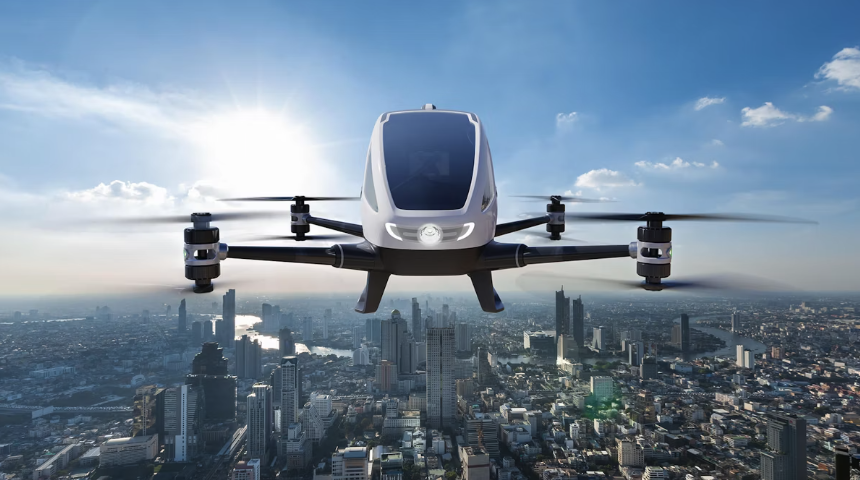

On April 27, 2026, a meaningful shift in transportation began to take shape over New York City. Joby Aviation launched a week long flight campaign, operating real electric air taxi routes between JFK and Manhattan. What typically takes over an hour by car was completed in under ten minutes by air, demonstrating that eVTOL technology has moved beyond concept and into real world execution.
This was not a controlled demonstration or a prototype test. The flights operated within existing aviation systems, integrating with FAA-regulated airspace and connecting to active heliports across the city. At the same time, infrastructure development is accelerating in parallel, with long term plans underway to electrify heliports and convert them into scalable vertiports capable of supporting continuous operations. The Port Authority’s reported $45 billion vision for vertiport infrastructure at major hubs like JFK and Newark signals that this is being treated as foundational, not experimental.
While much of the attention is focused on passenger mobility, the broader implication sits within logistics. This moment represents the early stages of what can be described as three-dimensional logistics, where transportation is no longer constrained to ground movement alone.
Historically, supply chains have operated within a two-dimensional framework, with trucks moving horizontally across roads while goods are staged and processed across flat yards. Every optimization, from routing to scheduling, has been built around this limitation. With eVTOL aircraft entering the system, that constraint begins to dissolve, allowing cargo to move above congestion instead of through it and enabling high priority goods to transition directly into an aerial layer of the network.
In practical terms, this introduces a new type of flow in which cargo can arrive at a port or distribution center, be processed through the yard, and then transition vertically into an air based network without ever entering traditional road congestion. Early pilot programs and partnerships across aviation, logistics, and mobility companies suggest that these systems are being designed to integrate with existing infrastructure rather than replace it, creating a multi-layered transportation model.
However, this shift does not eliminate existing challenges. It redefines them.
Even in a vertically integrated system, every asset still needs to be identified, staged, prioritized, and routed before it moves, and that responsibility continues to sit within the yard. As vertical transport becomes viable, the complexity of yard operations increases significantly because facilities must now coordinate timing across ground and air simultaneously. This includes aligning cargo readiness with air slot availability, dynamically prioritizing loads based on downstream constraints, and orchestrating movements to ensure seamless transfers between modes.
This is where the conversation moves from transportation to orchestration, and where Terminal becomes directly relevant.
Terminal Industries is building the software layer designed for exactly this kind of complexity. In a world where logistics expands beyond flat surfaces, a Yard Operating System cannot simply track assets; it must actively coordinate them. Terminal’s approach centers on turning the yard into a real-time decision engine, where every movement is structured, prioritized, and executed through systems like Missions™ that orchestrate tasks across people, equipment, and now, increasingly, infrastructure layers.
In a future where a container may need to move from a gate to a staging area and then immediately to a vertical transfer point for an eVTOL departure, timing is no longer flexible. It becomes precise, synchronized, and dependent on multiple systems operating in parallel. Terminal’s model is built around this kind of execution, where workflows are not reactive but dynamically coordinated in real time.
The concept of the yard as a static holding space is beginning to break down, and in its place a more dynamic model is emerging where the yard functions as a central coordination layer within a larger, multi-dimensional network. As infrastructure evolves to support vertical movement, the effectiveness of that system will depend on how well the yard can manage and execute these increasingly complex flows.
The introduction of eVTOL technology and vertiport infrastructure marks the beginning of a new phase in logistics. While the aircraft represent a visible and compelling innovation, the underlying transformation will be driven by how goods are managed before they ever leave the ground.
As transportation expands into the vertical dimension, the yard becomes the system that determines whether that speed can actually be realized.


