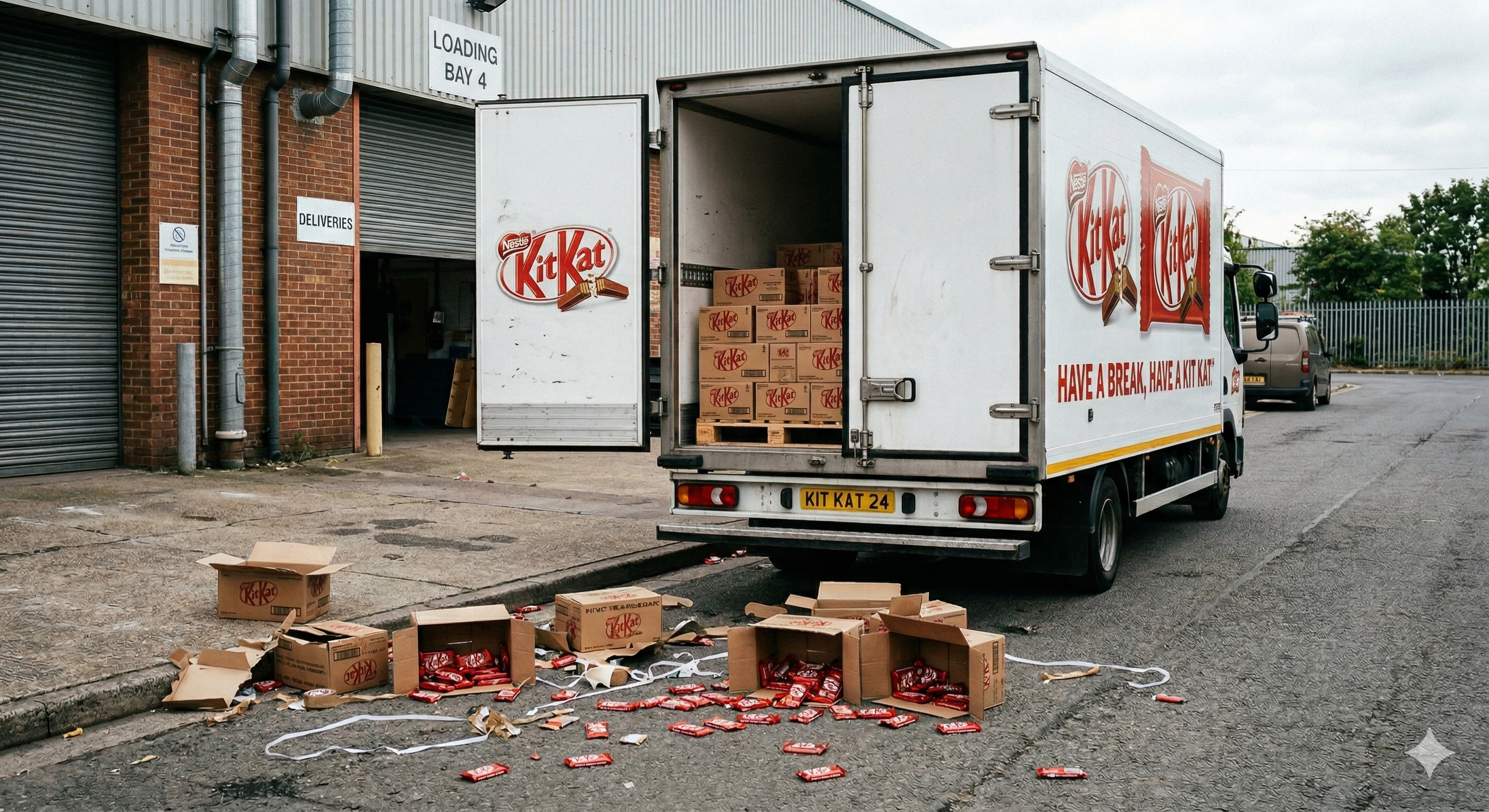

A truck carrying over 410,000 limited-edition Formula 1 KitKat bars didn’t just get stolen, it was intercepted. On a highway outside Turin, thieves posing as law enforcement stopped the truck, removed the driver, and disappeared with 12 tons of highly specific, time-sensitive cargo. This wasn’t random or opportunistic. It was informed, coordinated, and executed with precision.
This Was a Control Failure, Not Just a Theft
The details suggest that whoever orchestrated this knew exactly what was being shipped, when it was moving, and where it would be. They also understood how to stop it without raising immediate suspicion. That level of precision points to a deeper issue than theft. It reflects a lack of control over how goods are actually moving through the supply chain.
The Supply Chain Still Runs on Trust in All the Wrong Places
What makes this incident notable is not just the loss, but how simple the execution was. A truck was flagged down, the driver complied, and the cargo was taken without any system intervening or validating the situation. There was no mechanism to challenge identity, no real-time verification, and no immediate detection of abnormal activity. Much of the physical supply chain still relies on manual processes, assumed identities, and delayed visibility, which creates an environment where trust replaces verification.
The Yard Isn’t the Crime Scene. It’s the Blueprint
This incident didn’t happen in a yard, but it easily could have. The same conditions exist across many yard environments, including manual check-ins, paper-based workflows, fragmented systems, and limited real-time oversight. The yard is simply the clearest example of a broader issue. The physical layer of the supply chain has not been fully digitized or orchestrated, and that gap extends beyond the gate into in-transit operations.
Why This Shipment Was So Easy to Target
This shipment was particularly vulnerable because it was limited edition, time-sensitive, high-demand, and easy to resell. These characteristics increase value while also increasing risk. When execution is not tightly controlled, highly specific shipments become easier to track, intercept, and redistribute without detection.
The Real Problem: No Live System of Execution
Most systems today provide visibility into what was planned or what was reported after the fact. They do not provide a reliable, real-time understanding of what is actually happening on the ground. Without a live system of execution, disruptions cannot be prevented in the moment. They can only be analyzed afterward.
Where Terminal Fits In
This is the gap Terminal is designed to address. By introducing real-time orchestration, verified identities, system-driven workflows, and immediate anomaly detection, the supply chain shifts from reactive to controlled. The goal is not just efficiency, but the removal of ambiguity in physical operations.
Final Thought
This incident was not the result of an overly complex scheme. It was the result of a system that still allows critical moments of execution to operate without real-time control. As supply chains become more specialized and time-sensitive, these gaps will continue to create risk unless the underlying execution layer is modernized.


