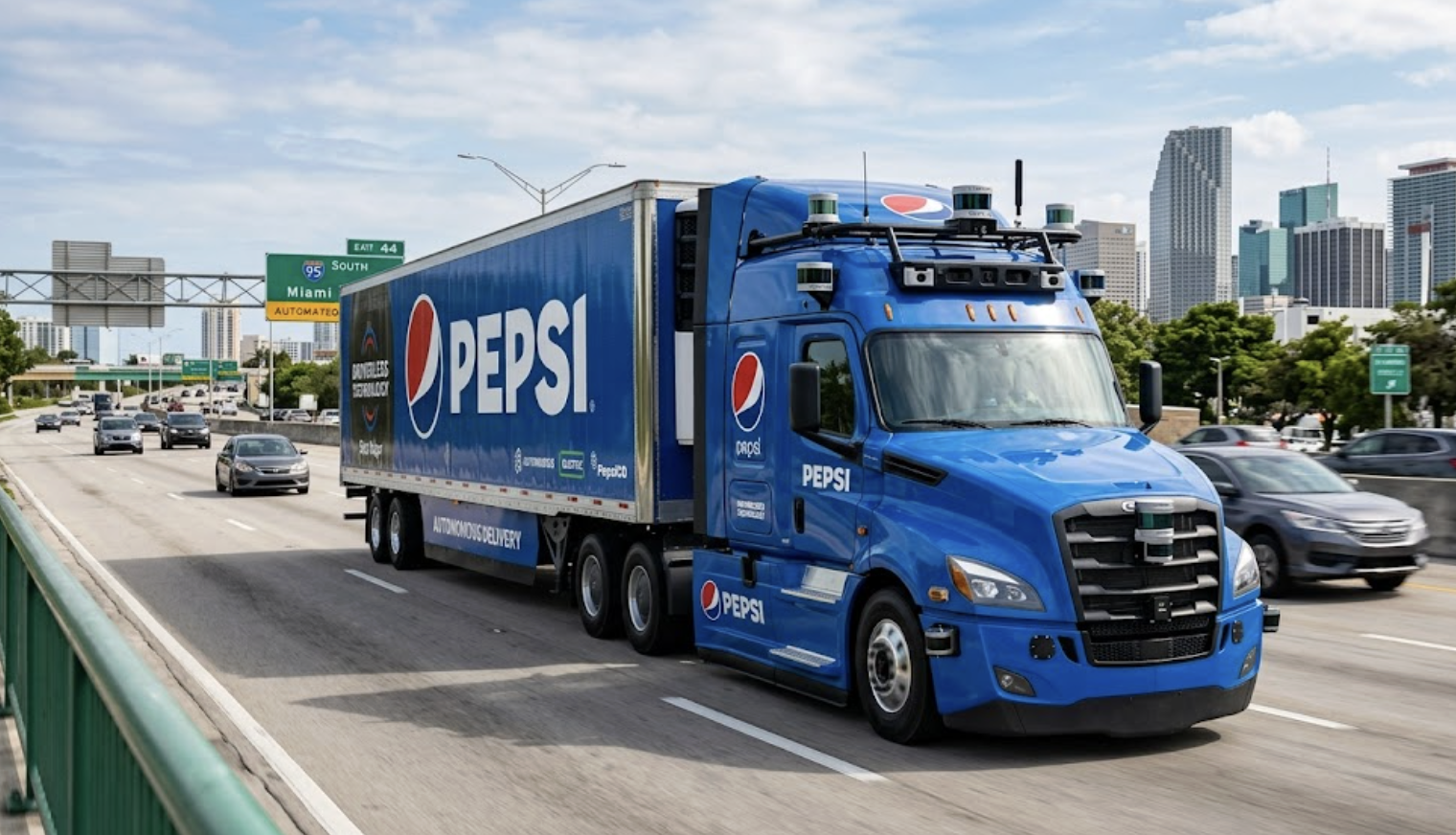

PepsiCo recently became the first major consumer goods company to deploy fully driverless trucks at scale, operating commercial routes without a human behind the wheel. The trucks are making deliveries to customers such as Walmart and Dollar General, achieving impressive levels of reliability and demonstrating just how quickly autonomous transportation is moving from experiment to reality.
For many, this feels like a glimpse into the future of logistics.
But there's an important question hiding behind the headlines:
What happens when the truck arrives?
The Autonomous Truck Era Has Arrived
For years, autonomous trucking has been treated as a distant possibility. The technology showed promise, but questions remained around safety, scalability, regulation, and operational viability.
Today, those questions are beginning to be answered.
Driverless trucks are no longer being tested in controlled environments. They are moving freight, serving customers, and becoming part of real supply chains.
The implications are enormous.
Autonomous trucks have the potential to reduce labor constraints, improve utilization, increase network flexibility, and keep goods moving around the clock. For an industry facing persistent driver shortages and growing pressure to move freight more efficiently, the appeal is obvious.
Yet transportation is only one piece of the logistics puzzle.
Because moving a trailer from Point A to Point B is not the same thing as moving it through a facility.
The Last Hundred Yards
The logistics industry often focuses on what happens on the road or inside the warehouse.
But between those two environments sits one of the most operationally complex and overlooked areas in the supply chain: the yard.
Every trailer entering a facility must be checked in, identified, routed, parked, assigned, tracked, and eventually loaded or unloaded. Dozens, hundreds, or even thousands of trailer moves can take place every day within a single operation.
In many facilities, these processes are still surprisingly manual.
Gate personnel verify information by hand. Drivers wait in queues. Yard locations are updated manually. Teams rely on radio calls, spreadsheets, paper logs, and institutional knowledge to coordinate activity.
A driverless truck may be able to navigate highways autonomously, but it still needs instructions when it reaches the gate.
It still needs to know where to go.
It still needs a dock assignment.
It still needs to interact with the physical environment of the yard.
And that is where many supply chains continue to face bottlenecks.
Autonomy Requires Coordination
One of the biggest misconceptions about automation is that individual technologies create autonomous operations on their own.
In reality, autonomy is a coordination problem.
A warehouse robot is only effective if it knows where inventory is located.
An autonomous truck is only effective if the destination facility can receive it efficiently.
Every automated system depends on accurate, real-time information about the physical world.
As more companies invest in autonomous vehicles, robotics, and AI-powered operations, the importance of the yard only increases.
The yard is where transportation meets warehousing.
It is where freight transitions between networks.
It is where delays become detention costs, missed appointments, congestion, and lost productivity.
And increasingly, it is where the next wave of logistics innovation will need to focus.
Building the Infrastructure for Physical AI
The future of logistics will not be defined by a single breakthrough technology.
It will be defined by how well those technologies work together.
Autonomous trucks. Robotics. Computer vision. AI agents. Automated warehouses.
All of these systems require a shared understanding of what is happening in the physical world.
That visibility starts in the yard.
At Terminal Industries, we believe the yard is evolving from a disconnected operational space into a digitally orchestrated environment. Through AI, computer vision, and real-time yard intelligence, operators can gain the visibility and coordination required to support the next generation of logistics technologies.
Because the future is not simply about autonomous trucks.
It's about creating facilities that are ready to receive them.
The Road Ahead
PepsiCo's deployment of driverless trucks marks an important milestone for the industry. It demonstrates that autonomous transportation is no longer a future concept. It's beginning to happen now.
But the lesson extends beyond trucking.
Every new wave of automation raises the same question:
Can the rest of the operation keep up?
As logistics becomes increasingly autonomous, the companies that gain the greatest advantage won't be the ones that automate a single process.
They'll be the ones that connect the entire flow of goods, from the highway to the warehouse door.
And that journey passes through the yard.


